

Andrew Manson, a recent Geography graduate and intern in the Energy and Environment Institute at the University of Hull, reflects on the written evidence submitted to the ongoing Environment, Food, and Rural Affairs Committee (EFRA) Inquiry on Climate and Weather Resilience in England.
What is the Inquiry about?
The Inquiry focuses on the UK’s ability to adapt and build resilience to climate related risks, and was launched by EFRA in September 2025, with a call for evidence by early October. The call for evidence encompassed coastal erosion, emergency service and local authority capability, landslide risk, and the ability of current systems to protect people, communities, and historic sites from climate-related events.
At the beginning of November, the Committee leading the Inquiry published the written evidence concerning climate and weather resilience. There were 65 submissions to the inquiry, from a range of parties including Historic England, the Environment Agency, the British Geological Society, local authorities, parish councils, community action groups, affected residents, and academics.
What does the evidence say?
The published evidence centres on the terms of reference for the Inquiry: scale and risk to communities, economy, and environment; strategies currently in place and what more is needed; impacts to communities, socially, psychologically, and economically; support provided to affected residents; the capacity of emergency services and local authorities; and the protection of historic sites and natural landscapes.
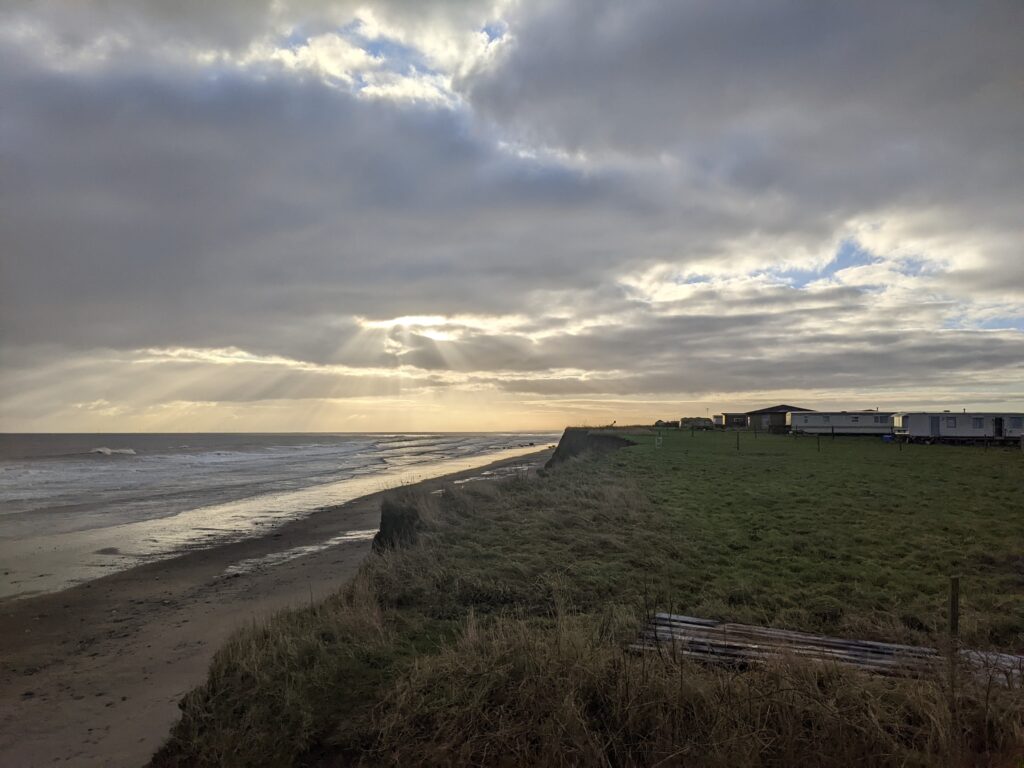
Perhaps not surprisingly, many of the community action groups and individuals who have submitted evidence are located on some of the fastest eroding coastlines in England, including the Isle of Wight, North Norfolk, Suffolk, and the Holderness coast.
There was a wide range of perspectives included in the evidence submitted, rooted in contributors’ local experiences, institutional roles, and lived experiences – but six common themes emerged across the submissions:
- There is a deep understanding of the inevitability of coastal change. Varying strategies for adaptation will be necessary consideration for managing coastal risk and increasing resilience. In some regions, the Site of Special Scientific Interest (SSSI) status requires the coasts to keep eroding naturally, particularly the World Heritage Site Jurassic Coast. This can create tensions between local communities and those in charge of maintaining the coastline.
- There is an overwhelming agreement between all parties about a lack of funding, particularly regarding homes that have had to be demolished owing to coastal erosion and landslides. Some parties were interested in the viability of something similar to Flood Re for erosion, so people living in affected areas can access home insurance. There was also a desire for compensation or greater funding regarding the demolition of homes at risk of coastal erosion. The current system relies on the resident paying for the cost of demolition and relocation, with grants of £6,000 for demolition costs. Often, demolition exceeds this figure, so the local authority must fund the difference.
- There is a sense of inequality from residents in the riskiest areas. There is a perception of being deserted, not being listened to, and a lack of empathy from the government and other institutions. This was often mentioned alongside a lack of funding to adapt and move, leaving residents feeling isolated and hopeless. This is further compounded by the high social vulnerability often found in coastal communities.
- Local authorities are overburdened. Councils frequently mention being under-resourced and unsure of the full cost of coastal erosion. Demolition costs for homes at risk can be borne by local councils, and staff are regularly pulled from different departments to address coastal erosion, meaning that other council jobs aren’t achieved. This leads to a lack of capacity to fulfil council responsibilities, and a feeling of neglect by residents.
‘The coast is not properly valued as an asset to the nation’ (East Suffolk Council, CWR0042)
- The coastline ought to be valued as if it belongs to the nation, not only the villages and towns situated on it. There is a clear need for national commitment to addressing coastal risk, and for more integration between organisations, specifically between local authorities that have already dealt with the problems before, and from academics and scientific institutions about the best ways to use existing data and what more could be harnessed. It is also necessary to prioritise community engagement so the people living in affected areas are included in decision making. This should be done at multiple scales, from the local level to the national. For example, much of the evidence advocates for the introduction of a coastal minister, which would facilitate increased attention, funding, and policy at the national scale.
- The full impacts of coastal erosion are still unknown. For example, there is still a lack of understanding of the full social, emotional, and mental costs of living with coastal risk. The pilot Mind scheme in Norfolk was well received by residents, highlighting that there is a mental impact from the risk of coastal erosion that deserves further exploration. Hopefully this will lead to a more localised understanding of the impacts enabling a better response and preparedness, but also a contribution to action plans to help other communities at risk.
The EFRA Inquiry has been an opportunity for the people and groups associated with coastal communities to raise their concerns and voice their opinions about the impacts of coastal erosion and landslides. The evidence was guided by the Inquiry’s terms of reference and from that it was possible to see similarities between the evidence, suggesting that the challenges faced by one coastal community are shared by others. This commonality has helped to pick out the naturally occurring themes: the inevitability of changing coasts; the lack of available funding; a sense of injustice from affected communities; the strain felt from local authorities; and the unknown impacts that are still being understood. Taken together, these themes demonstrate that the Inquiry represents a further step in an ongoing process of understanding and responding to coastal change.