The Living Glossary approach straddles an inherent yet productive tension: a glossary traditionally offers fixed, concise definitions, whereas a living process embraces multiplicity, plurality, and change. At times, ‘living’ and ‘glossary’ may seem to pull against each other.
This is no bad thing – it is a feature rather than a flaw. Living Glossaries have multiple uses, so while a central question is how they can share consensus without flattening difference, your project can exist anywhere on a living – glossary continuum.
The boxes below trace the choices we made and offer prompts to help you design your own Living Glossary – paying attention to how managing the tensions at the heart of this approach can make it work for you.
Shared scripts: co-creation or curated choices
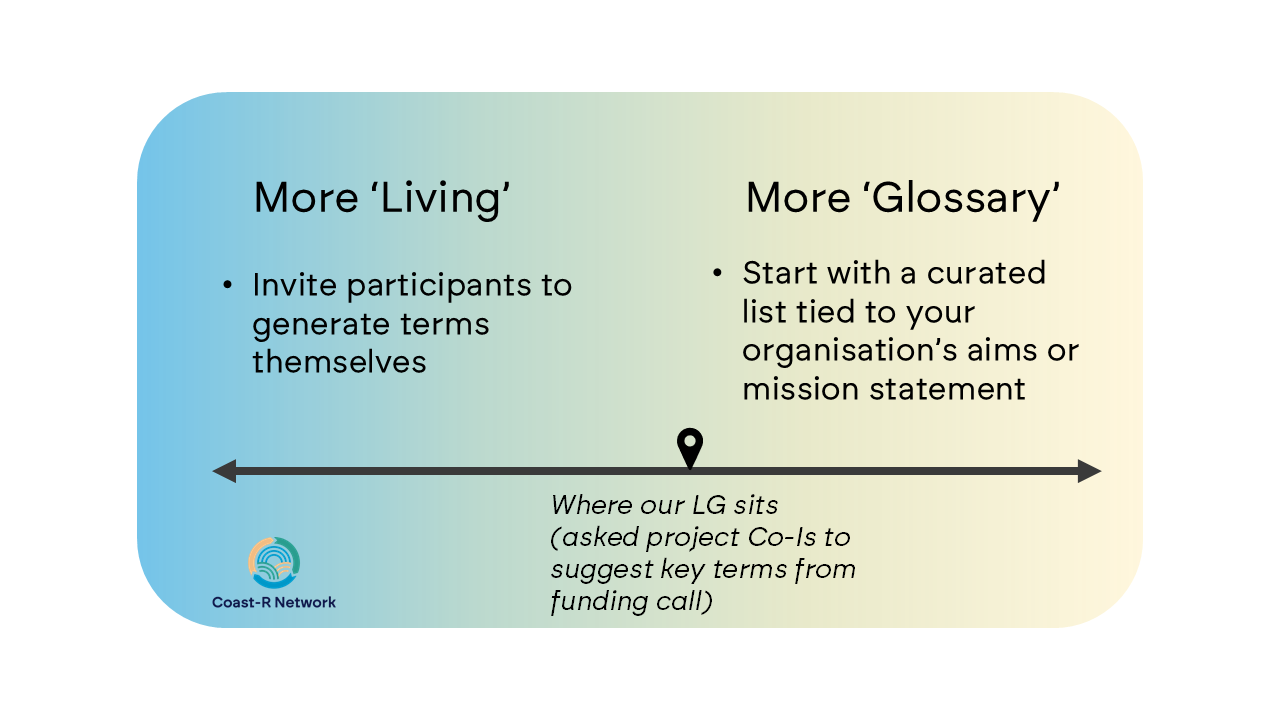
When designing a Living Glossary, one of the first decisions encountered is how to choose terms to explore.
For your own glossary, consider how much control you want over term selection. This decision sits on a spectrum: at one end, a more ‘living’ approach invites participants to generate terms themselves. This could happen before the workshop, through surveys or email requests, giving you time to sort and cluster ideas. Alternatively, it could happen during the session, allowing terms to emerge organically from the group. This method fosters creativity and co‑ownership but can lead to long lists of options and so requires strong facilitation.
At the other end of the spectrum, a more ‘glossary’ approach starts with a curated list tied to your aims, strategy, or research framework. For example, you might extract key concepts from policy documents or organisational priorities. This ensures clarity and alignment but offers less room for participants to shape the agenda.
For the Coast‑R Living Glossary, we selected words suggested by Coast‑R Network and Resilient Coastal Communities and Seas (ReCCS) project Co‑Investigators. This approach aimed to ensure that everyone in the room was already invested in the chosen terms, informed by the research programme’s core remit.
From buzz to text: capturing workshop vitality
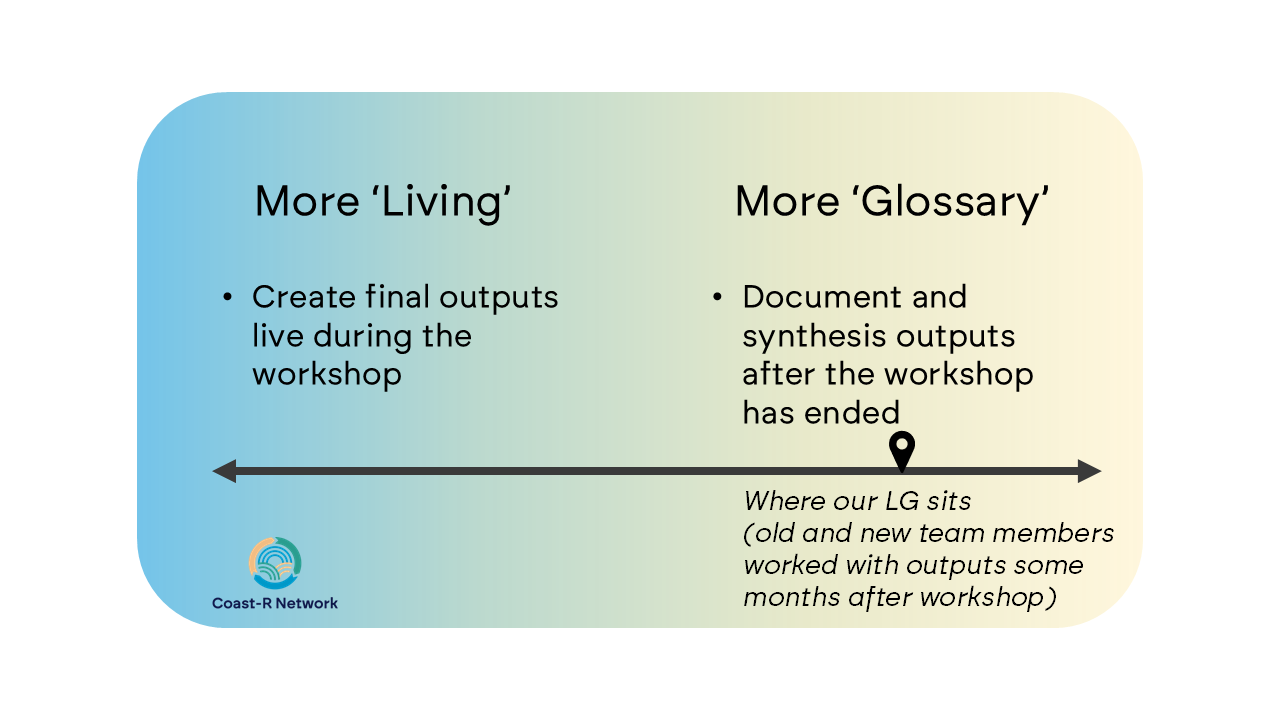
Another key choice is when and how you transform the energy of the room into something legible. You can crystallise definitions in situ, inviting participants to agree the final wording before they move on, or you can return to the material afterwards, giving your team time to synthesise what was said. Each route has its strengths. Creating outputs live carries a sense of immediacy and progress, though it demands time, careful facilitation, and a willingness to sit with messiness. Translating later allows you to cross‑check notes, compare interpretations and polish phrasing, yet it introduces distance from the original conversations and carries the risk of inadvertently layering your own assumptions onto the group’s work.
Our process looked a little like a jigsaw. Team members who had not been part of the original workshop worked with those who had to create our glossary. We took care not to overwrite the room’s original intent, while remaining transparent by acknowledging that, in some cases, our own readings may have influenced how we recreated our understanding of the outputs. On reflection, a facilitator–scribe model may have helped us, where one person guided the conversation and another captured group member contributions verbatim to create a narrative of the discussion. By documenting where tensions surfaced, new links were made, or definitions shifted, the dynamism of the glossary building process could have been left less open to subsequent interpretation. You could also ask participants to note the sector or discipline they represent to gauge if and how perspectives coalesced and where they diverged. Photos of the evolving sheets or optional audio recordings of the discussion (made with participant consent) could also help make the transition from buzz to text easier.
Finding your footing: navigating consensus and conflict
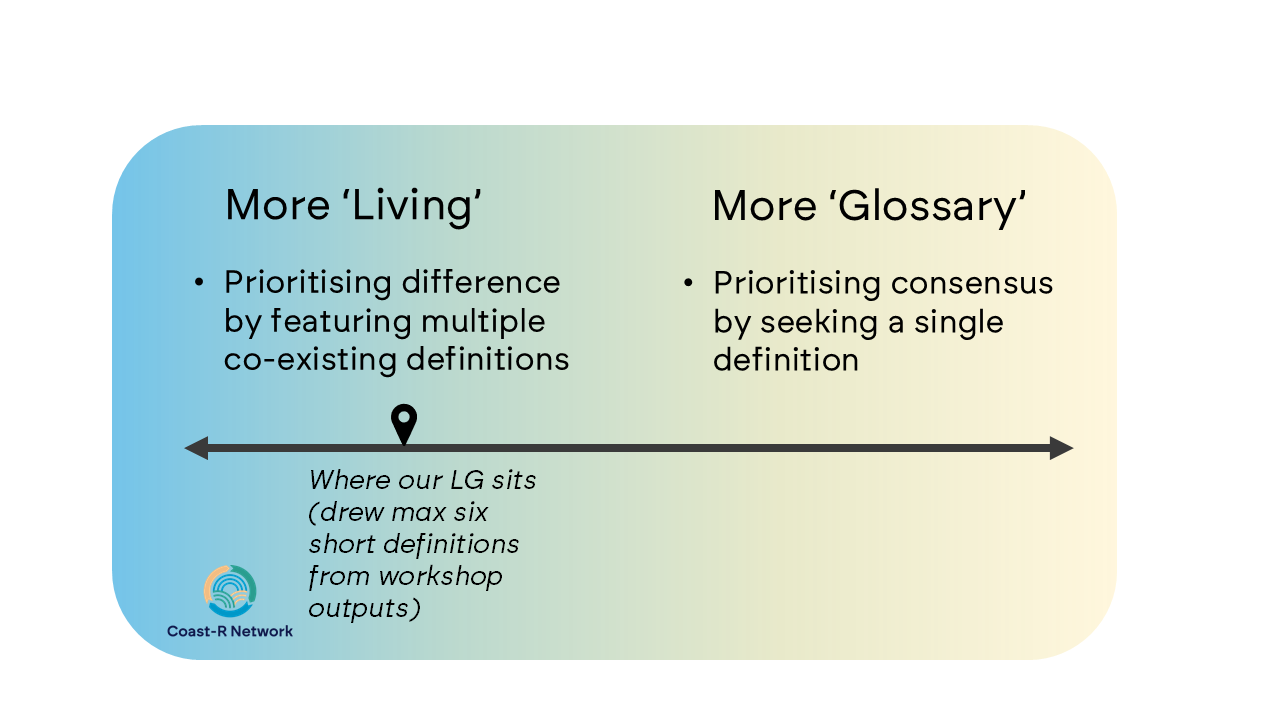
Turning workshop outputs into glossary entries means choosing how to balance the emergence of both agreement and disagreement in definitions.
In our ‘Resilience’ definition exercise for instance (you can view an animated version of this on The Coast-R Living Glossary page) the workshop groups debated whether this term should signal thriving – a positive transformation – or whether ‘functioning in the face of change’ better captured the uncomfortable work of continuing in the face of adversity. This debate became part of our Living Glossary itself. Rather than forcing a single line, we chose to present multiple short definitions that sit alongside one another, giving room for difference while still showing where concerns were amalgamating. This allowed us to capture the nuance within what ‘resilience’ meant for our participants. For a term widely used in climate adaptation, resilience emerged here as at once hopeful and hard, necessary and necessarily multifaceted, encompassing different capacities and capabilities to respond to and recover from change.
Some other possibilities to consider:
- You could rank or categorise the level of consensus for each term. For example, indicate which words held broad agreement and which provoked debate – and even note which backgrounds were most aligned or most apart, such as academics versus policymakers. This could help your living glossary users see where differences lay and why.
- You could produce longer glossary entries to give a sense of how a term has evolved over time, and situate your own discussions within that ongoing flux of meaning.
- You could add a meta-layer of reflection to your Living Glossary. For instance, for each term, you might ask: Why was consensus hard? Why might it matter? Do we even need consensus here? These questions can deepen understanding and invite readers to think critically about the work of meaning making and what we want it to do for us.
You might wish to consider the question raised in our own resilience example: “Who gets to decide?” Whose voices shaped these definitions – and whose were absent? Naming those gaps can make your glossary more transparent and possibly open to future contributions.
Case study: TRANSECTS Interdisciplinary LG
As we have seen, a Living Glossary is shaped by the purposes we imagine for it and grows out of the conversations we have while making it.
This became especially clear for our colleagues on the Transitions in Energy for Coastal Communities over Time and Space (TRANSECTS) project, who developed their own Interdisciplinary Living Glossary (available in the Further Reading section on The Coast-R Living Glossary page). The project brings together researchers from eight different subject areas across science, humanities, and social science backgrounds, and so it was important for the team to talk through the different histories and assumptions each member carried around the key terms they would be using. These discussions helped bring clarity – around how and why team members understood particular words in certain ways, and in their subsequent communications about their work with each other and with project partners.
The aim was not to iron out every difference. Instead, by discussing existing definitions drawn from other sources (such as academic literature) the team built nuance into their definitions and simultaneously explored the limits of how their chosen terms could be used. The outcome was not only the glossary itself, but also the reflective spaces created through these conversations.
In the end, the team was surprised by how few disciplinary divides in understanding needed to be explicitly marked in the glossary itself – something they had anticipated in their resource’s design. They had created a Living Glossary tailored to their own project, one which largely moves beyond single disciplinary definitions to instead present a tool that helps them articulate the particular position their work takes on the concepts they use. As TRANSECTS Research Associate Sofie Jaeger describes, the glossary has become a kind of “journal” of the team’s evolving understandings – a record of how their ideas shift as the project unfolds. Because the research continues to develop, its glossary continues to live, taking on new layers of meaning as further findings, connections, and conclusions emerge.
Our balancing act: crafting a glossary for diverse users
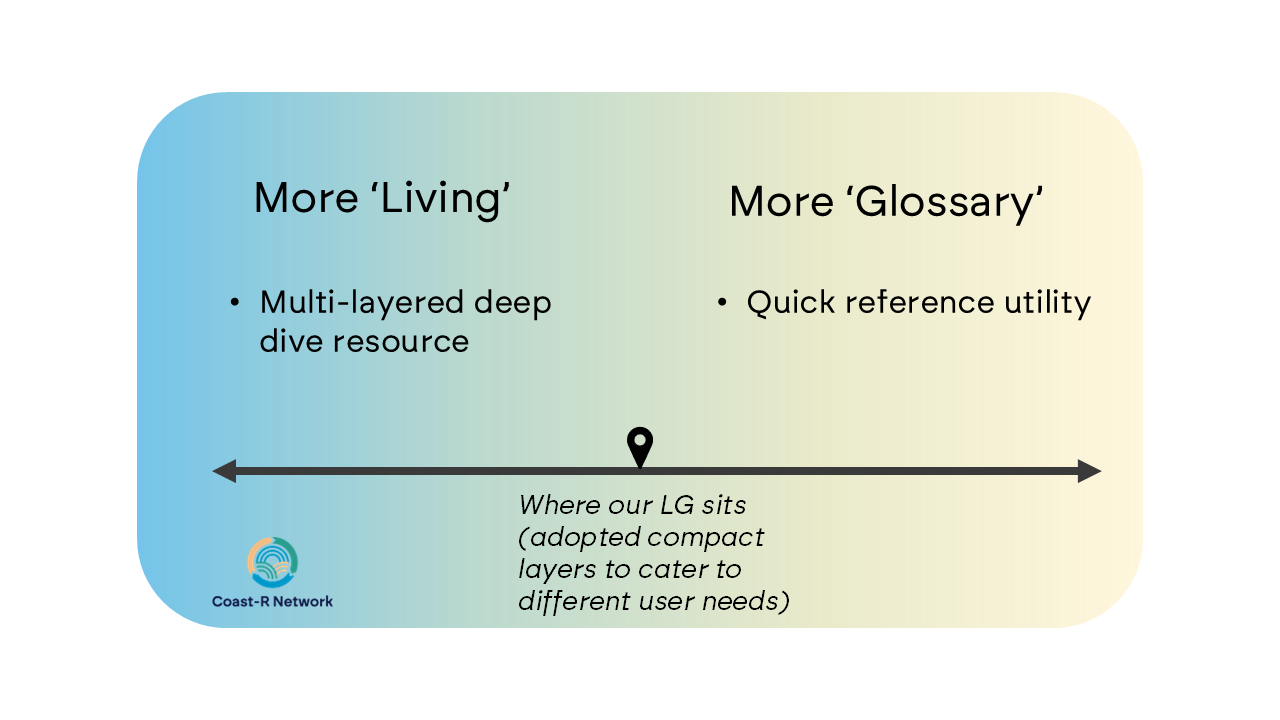
During the Coast-R Living Glossary workshop, we asked our participants to envision contexts in which they might use this resource. Each of these situations may sit in different places on the ‘living – glossary’ continuum. Community partners may for example value locally grounded and concrete examples; cross‑sector stakeholders may prefer a shared vocabulary to coordinate action; whilst decision‑makers may need succinct formulations that translate well into policy and briefings. And of course, as we can see with the TRANSECTS project example, a living glossary may speak to many different audiences: used within a team to guide project development, and then externally to communicate this to project partners.
We tried to thread this needle by building user choice into the Coast-R Living Glossary. Working for readers with different preferences through a layered format, it was designed to accommodate varying levels of engagement. Featuring a selection of definitions for each term, drawn from the annotations that participants added to each page, this meaning making is then complemented by an etymology for each term, and a selection of further readings exhibiting how its meanings have been debated by others. The structure of each glossary entry also stays consistent so readers can get their bearings quickly and then choose how deep they wish to go.
Living legacy: how dynamic your glossary might remain
Once the work of compiling your Living Glossary is complete, it is time to decide how ‘living’ your glossary should remain, and how you will steward this over time.
You might choose to invite open contributions from the public, or submissions from a chosen community, featuring visible change logs and frequent updates. Alternatively, you may prefer moderated inputs with scheduled review cycles and clear editorial criteria.
In either case, decide at the outset who will review changes to your glossary, how consensus and conflict will be handled, and when entries are archived or frozen. Version numbers and dates can help readers cite responsibly, and contributor acknowledgements make labour visible. Think too about where the glossary will live – on a website with interactive features, in a report for stable reference, or both – and make sure to be realistic about how resource intensive your chosen form of maintenance will be.
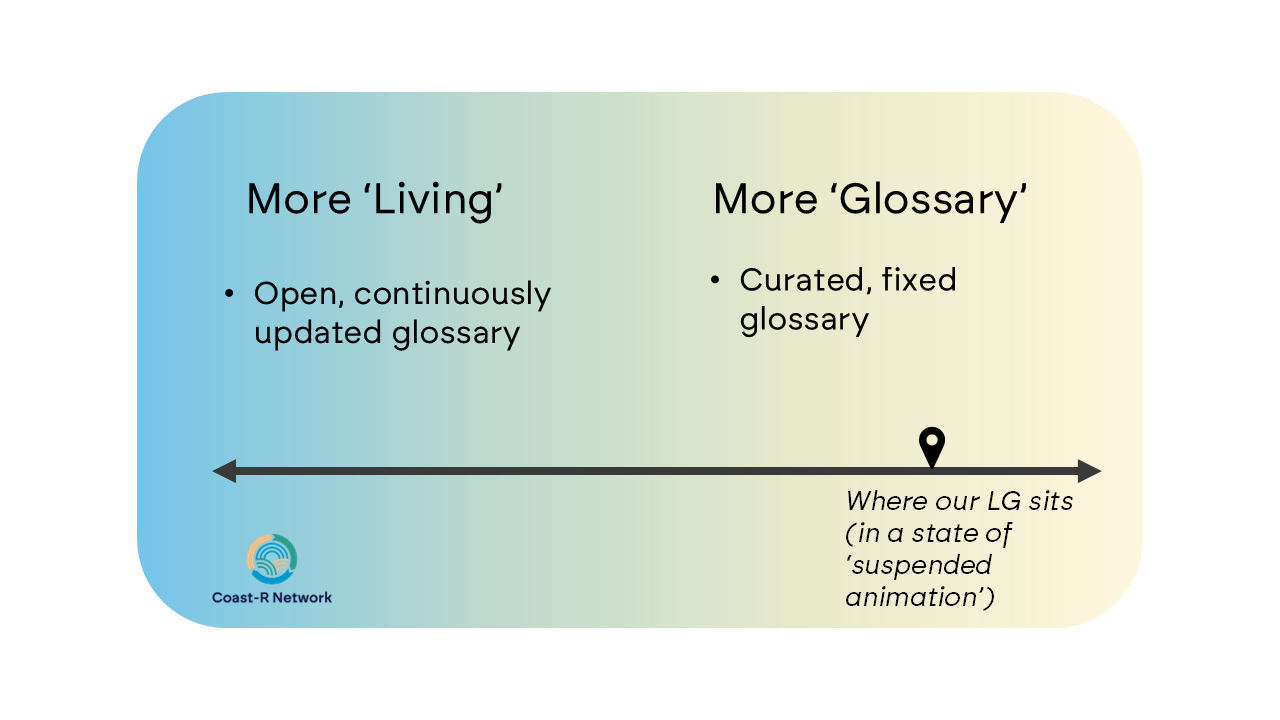
For the Coast‑R Living Glossary, we ultimately chose to ‘suspend the animation.’ Rather than keeping our glossary open for continual edits, we created a suite of resources that capture what our workshop participants produced at that moment in time – collating different groups’ definitions for each of our key terms, as well as the tensions and traces of conversation that shaped them, and a sense of where these terms came from and where they might be going. Our hope is that the project’s living quality continues not through ongoing updates to our pages, but through others picking up these tools and making their own – adapting the method, running new workshops, and growing fresh glossaries that reflect different contexts and voices.
If you are interesting in making a living glossary and would like further advice, please contact us (COASTR@hull.ac.uk). Or if you have made a living glossary and would like to share it, you can also contact us.